

EOD drawdown vs trailing drawdown comes down to one question: when does your loss floor move? An intraday trailing drawdown follows your highest equity tick by tick, open profit included. An end-of-day (EOD) drawdown moves only from your closing balance, and a static drawdown never moves. On a $50K account with a $2,000 limit, that difference can decide whether one trade that runs up and comes back ends the account.
Rules and prices checked on each firm's official site on 20 October 2026.
Key takeaways
- An intraday (real-time) trailing drawdown raises your floor with peak equity, unrealized profit included, so a winning trade you give back still uses up room.
- An EOD trailing drawdown raises the floor once per session from your closing balance. At most firms the floor is still enforced in real time, so an intraday dip to it can breach the account.
- A static drawdown never trails. Traders Launch sells Static plans, and the Direct accounts at Blue Guardian Futures use a static floor.
- Most trailing floors stop at the starting balance or at the starting balance plus $100, then stay there.
- A payout can lock the floor early (Top One Futures, Blue Guardian Futures, FundedNext Futures Flex, LucidFlex) or leave it where it was (Goat Funded Futures).
Drawdown types at a glance
| Type | When the floor moves | Does open profit raise it? | Where it usually stops | Examples on 20 Oct 2026 |
|---|---|---|---|---|
| Intraday (real-time) trailing | Continuously, on every new equity high | Yes | Starting balance or starting balance + $100 | Funded LucidDaily, Goat Instant Classic, Top One Elite Access Intraday (funded), Earn2Trade Live accounts |
| End-of-day (EOD) trailing | Once per session, from the closing balance | No, only what you keep at the close | Starting balance or starting balance + $100 | LucidFlex, E8 Futures Signature and E8 Zero, FundedNext Flex and Rapid, Top One Elite Daily, Traders Launch Premium |
| Static | Never (until a payout, at some firms) | No | Fixed below the starting balance | Traders Launch Static, Blue Guardian Futures Direct, Earn2Trade $200K and $400K funded accounts |
What is the difference between EOD and trailing drawdown?

A ratchet only turns one way: a trailing drawdown floor rises with your account and never comes back down.
Every futures prop account has a maximum loss limit: a balance floor that ends the account if you reach it. "Trailing" means the floor follows your account up as you make money. "EOD" and "intraday" describe when it follows. Static means it doesn't follow at all.
Intraday (real-time) trailing drawdown
An intraday trailing drawdown tracks your highest equity at any moment, including unrealized profit on open positions. Top One Futures describes its funded Elite ACCESS Intraday floor as tracked "live, tick by tick", and the floor never moves back down. If a trade runs $1,400 in your favor and you close it flat, the floor has still risen $1,400. Goat Funded Futures puts it bluntly in its help center: treat unrealized profit as spent.
End-of-day (EOD) trailing drawdown
An EOD trailing drawdown recalculates the floor once per session from your closing balance. Intraday spikes that you give back don't raise it. FundedNext Futures updates its maximum loss limit at 5:00 PM CT. Platform vendors build the same split into their risk engines: Tradovate's prop-firm risk settings offer a trailing drawdown mode of "EOD" (updates at 4 PM CT) or "RealTime", which includes unrealized profit. EOD trailing fits how futures already work: CME Group sets an official daily settlement price for every contract and marks positions to it each day.
EOD does not always mean you can dip below the floor
"EOD" tells you when the floor moves, not always when a breach is checked. Most firms in this post enforce the EOD floor in real time:
- FundedNext Futures: a floating loss that reaches the maximum loss limit during a live trade breaches the account instantly.
- E8 Futures: the account is closed if equity or balance reaches the loss level.
- Earn2Trade: open equity losses count, so an open position that dips below the minimum balance fails the evaluation.
- Topstep: the limit updates at the end of the day but is monitored in real time, unrealized P&L included.
Two help centers read differently. Top One Futures' Elite ACCESS article says intraday drops below the level don't count unless the day closes below it. Goat Funded Futures' drawdown article shows an EOD account dipping $300 below the floor intraday with no breach, while its EOD and Flex plan pages say your balance or equity cannot fall below the level. If you plan to lean on that difference, get the answer from the firm's support in writing first. Our Fine Print tracker logged a similar clarification on 27 August 2026, when Tradeify added to its rules that its EOD level only updates at the close but is enforced in real time (Fine Print updates).
Static drawdown
A static drawdown is a fixed floor that doesn't trail. Traders Launch's Static plans carry a $500 floor on $25K, $1,000 on $50K and $2,000 on $100K, and the cards say "Does not trail". The trade-off is size: a static floor is usually smaller than a trailing one on the same account, but every dollar you make adds to your room.
EOD vs trailing drawdown on a $50K account: a worked example
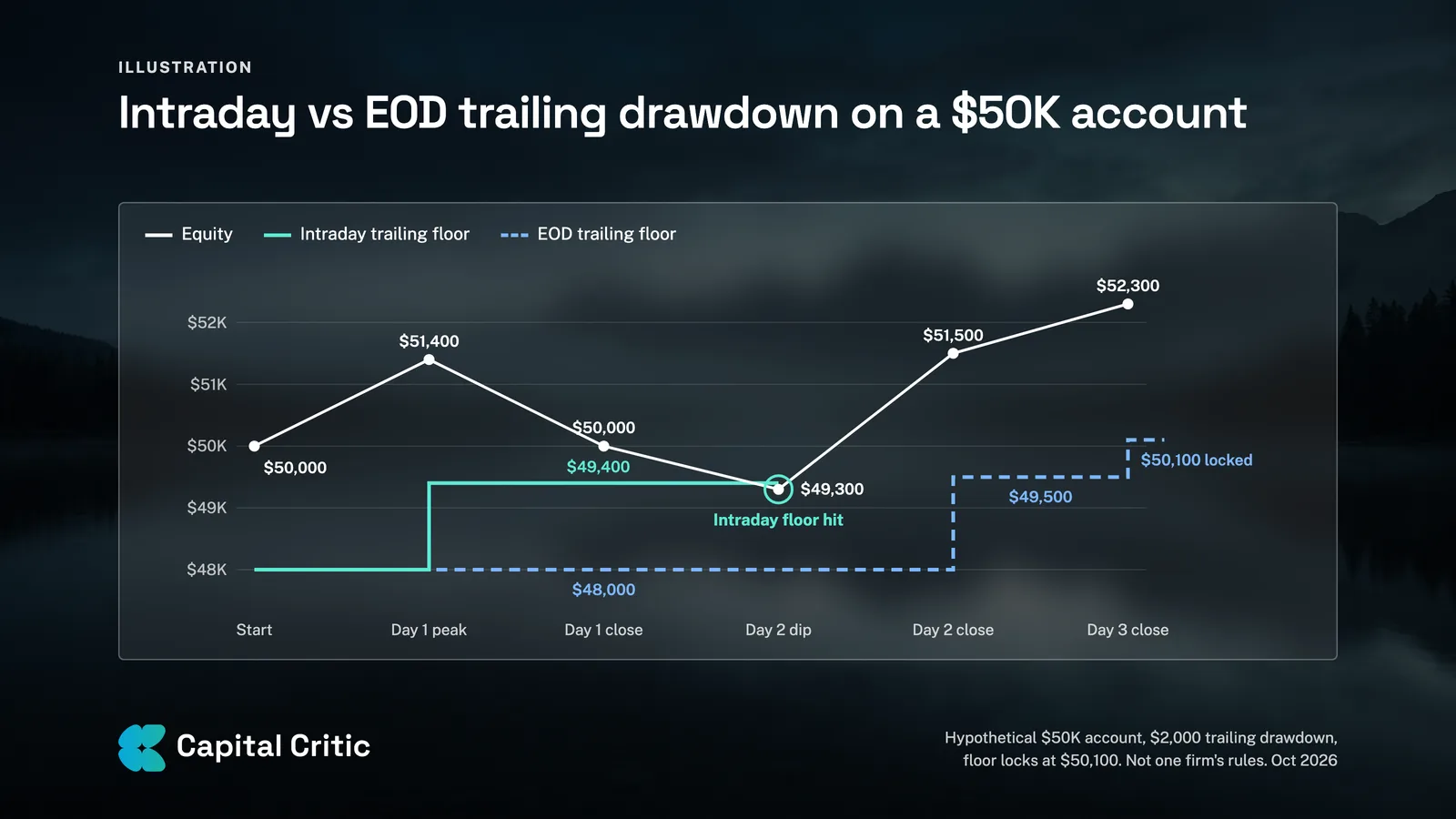
Illustration of the worked example below: the same trades against an intraday floor and an EOD floor. Not one firm's rules.
The same trades can breach an intraday account and leave an EOD account untouched. Here is a hypothetical $50K account with a $2,000 drawdown that locks at $50,100. It's an illustration, not one firm's rule set.
| Moment | Equity | Intraday trailing floor | EOD trailing floor | Static floor |
|---|---|---|---|---|
| Start | $50,000 | $48,000 | $48,000 | $48,000 |
| Day 1: an open trade peaks | $51,400 | $49,400 | $48,000 | $48,000 |
| Day 1: trade closed flat, session ends | $50,000 | $49,400 ($600 of room) | $48,000 ($2,000 of room) | $48,000 |
| Day 2: equity dips during a trade | $49,300 | Breached | $48,000 ($1,300 of room) | $48,000 |
| Day 2 close | $51,500 | n/a | $49,500 from the next session | $48,000 |
| Day 3 close | $52,300 | n/a | $50,100, locked | $48,000 |
Three things stand out:
- The intraday account lost $1,400 of room on Day 1 without losing a dollar of balance, because the floor followed the open profit.
- The EOD account only moved its floor after closes that set a new high: Day 2's $51,500 close lifted it to $49,500.
- Day 3's close at $52,300 would have put the EOD floor at $50,300, but the lock caps it at $50,100.
This is why intraday plans are usually the cheaper version of the same product. Lucid prices its LucidDaily evaluation lower with an intraday drawdown than with EOD, and funded LucidDaily accounts use intraday regardless of the evaluation choice. Our Lucid Trading account types guide covers the full lineup.
When does a trailing drawdown stop trailing?

Once a trailing floor locks, it stays fixed like an anchor point, and new profit adds room above it.
Most trailing drawdowns stop, or lock, once the floor reaches the starting balance or the starting balance plus $100. From then on the floor is fixed and your profits add room. The lock triggers when your balance reaches the starting balance plus the drawdown amount (plus $100 where the lock sits at start + $100).
| Firm and plan | $50K drawdown | Lock triggers at | Floor locks at |
|---|---|---|---|
| Lucid Trading Flex, Pro, Daily, Direct | $2,000 | $52,100 | $50,100 |
| FundedNext Futures Flex | $1,500 | Floor reaches $50,100 | $50,100 |
| FundedNext Futures Rapid Pro and Daily | $2,000 | Floor reaches $50,100 | $50,100 |
| Top One Futures Instant Sim Funded | $2,000 | $52,100 | $50,100 |
| E8 Futures Signature | $2,000 | $2,000 of closed profit, or the first payout request | $50,000 |
| Goat Funded Futures EOD and Flex | $2,000 | $52,000 | $50,000 |
| Goat Funded Futures Instant Classic (intraday) | $2,500 | $52,500 | $50,000 |
| Goat Funded Futures Daily Payouts (funded) | $2,000 | $52,100 | $50,100 |
A few exceptions matter. E8 Zero's evaluation drawdown never locks, so it keeps trailing as long as you keep making money; it locks at the initial balance once you reach the performance stage. On Top One Futures' funded Elite ACCESS Intraday accounts, the intraday floor keeps trailing past the usual lock level until your first payout request, then locks at the starting balance plus $100. Earn2Trade's EOD drawdown trails until it reaches the starting balance. Topstep counts funded balances from $0: on a 50K Express Funded Account the limit starts at minus $2,000 and locks at $0 once the balance reaches $2,000.
Lock points do get reworded. On 9 September 2026 Fine Print logged Goat Funded Futures' help center describing a starting balance plus $100 lock for Daily Payouts' intraday drawdown, while Instant Classic still locks at the starting balance. The current help center matches that split.
How futures prop firms differ on drawdown today
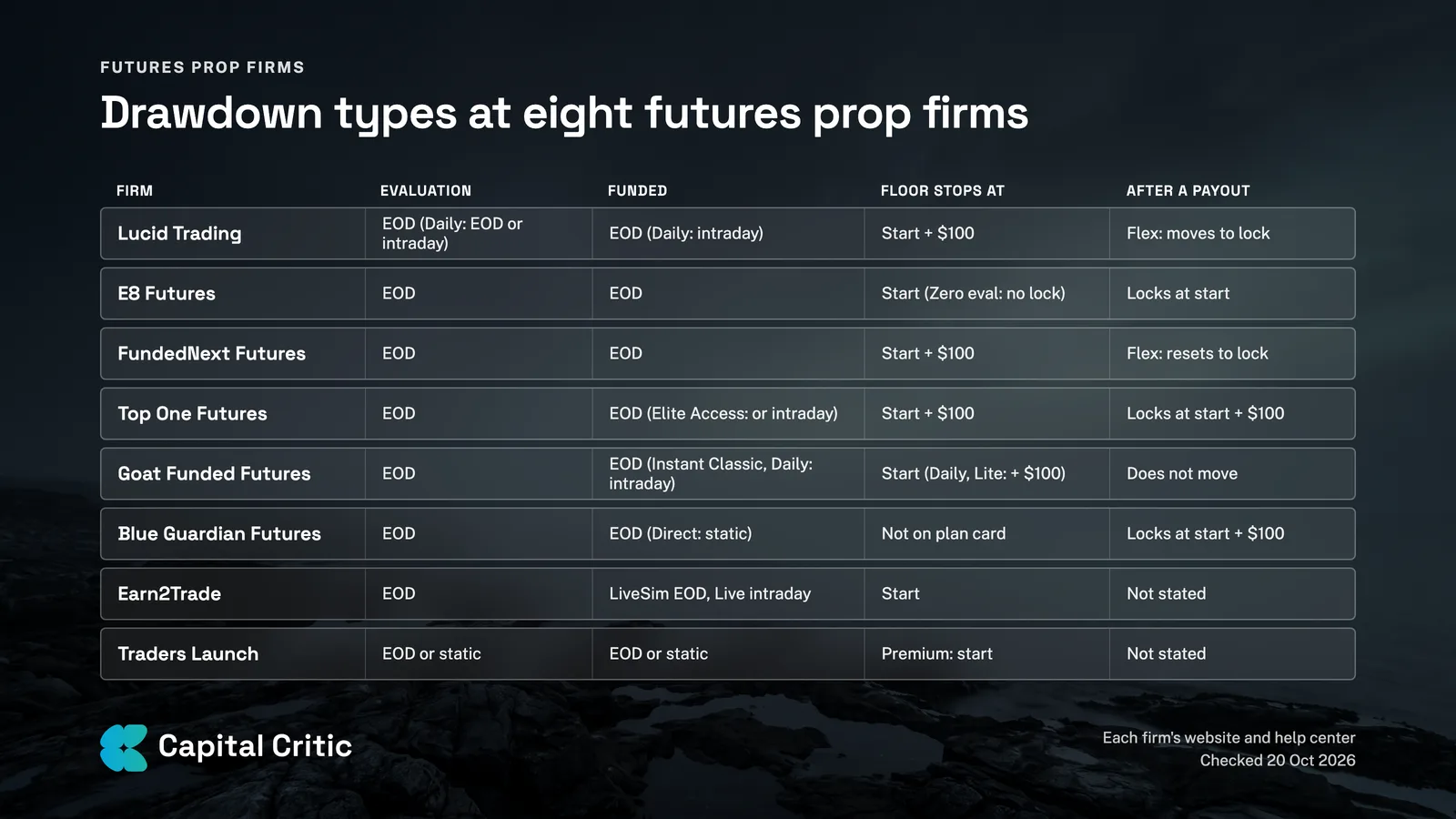
Drawdown types at the eight futures firms in our offer book. Source: each firm's website and help center, checked 20 Oct 2026.
All eight futures firms in our offer book use EOD trailing as their default, and six of them also sell an intraday or static version. Here is what each firm's own site and help center showed on 20 October 2026.
| Firm | Evaluation drawdown | Funded drawdown | Floor stops at | After a payout |
|---|---|---|---|---|
| Lucid Trading | EOD on Flex and Pro; LucidDaily lets you pick EOD or intraday at checkout | EOD on Flex, Pro and Direct; intraday on every funded LucidDaily account | Starting balance + $100 | LucidFlex: the floor moves to the locked level when you request a payout |
| E8 Futures | EOD dynamic (closed profit only) on E8 Signature and E8 Zero | EOD dynamic | Starting balance; no lock in the E8 Zero evaluation | Locks at the starting balance on the first payout request |
| FundedNext Futures | EOD trailing on Flex and Rapid Pro and Daily | EOD trailing on Flex, Rapid and Direct | Starting balance + $100 | Flex: the first withdrawal resets the floor to the lock point |
| Top One Futures | EOD on Elite Daily and Elite Access | EOD on Elite Daily, Instant and Ignite; Elite Access lets you pick EOD or intraday | Starting balance + $100 | Locks at the starting balance + $100 on the first payout |
| Goat Funded Futures | EOD on every evaluation | EOD, except intraday on Instant Classic and funded Daily Payouts | Starting balance (Daily Payouts and Instant Lite: + $100) | Does not move or lock the floor |
| Blue Guardian Futures | EOD trailing on Standard, Reserve and Express | EOD trailing; static on Direct | Not stated on the plan cards | Locks at the starting balance + $100 after any withdrawal |
| Earn2Trade | EOD on Trader Career Path and Gauntlet Mini | EOD on LiveSim; intraday trailing on Live; fixed on $200K and $400K funded accounts | Starting balance | Not stated in the drawdown articles |
| Traders Launch | EOD on Premium; static on Static plans | Same as the evaluation | Premium: starting balance | Not stated in the drawdown rules |
All eight are in our offer book: code CRITIC gets you the best available offer at each, and current prices are on our prop firm offers page. CRITIC doesn't stack with other codes.
Payout records add context that a rule table can't. On our on-chain payout tracker, Top One Futures shows $1,198,381 across 1,036 payouts in the last 30 days and Goat Funded Futures $373,845 across 272. E8 Markets ($1,430,414), FundedNext ($13,971,727) and Blue Guardian ($4,516,799) are tracked company-wide, so those figures include their non-futures programs. These are verified on-chain floors, not complete payout volume: bank wires and card payouts leave no public trace. Lucid Trading, Earn2Trade and Traders Launch aren't on our payout tracker.
Firms outside our offer book
Topstep uses an EOD-updated maximum loss limit that it monitors in real time and that locks at the starting balance, and its Topstep Labs drops have included a $50K Static Drawdown Trading Combine, which Fine Print logged on 2 October 2026. MyFundedFutures runs both types: intraday trailing on standard Rapid funded accounts and EOD on Rapid EOD. Our post on why MyFundedFutures replaced intraday drawdown with a consistency rule covers that switch. Apex Trader Funding's trailing-threshold help article is now labeled "Legacy", so check its current plan pages before comparing. For side-by-side rules, see Lucid Trading vs Topstep and Top One Futures vs Topstep, or our Topstep review.
What happens to your drawdown after a payout?
It depends on the firm, and it matters more than the drawdown type once you're funded. Firms take one of three approaches:
- Lock on payout. The floor jumps to its lock level the moment you withdraw, even if it hadn't reached it yet. Top One Futures, Blue Guardian Futures, FundedNext Futures Flex, LucidFlex and E8 Futures work this way.
- No change. Goat Funded Futures says a payout doesn't move or lock the floor: your balance drops by the payout and the floor stays where it was.
- Reset to a zero-based floor. Topstep sets the funded account's limit to $0 after the first payout, so the remaining balance is your whole cushion.
Top One Futures gives a worked example on a $100K account: grow it to $105,000, take a $3,000 payout, and the balance is $102,000 with the floor locked at $100,100, leaving $1,900 of room. On a generic $50K account locked at $50,100, a $2,000 payout from $53,000 leaves $900. Goat's version is the 25K Daily Payouts account: a maximum $650 payout from its $26,100 minimum balance leaves $350 above a floor locked at $25,100.
This is why several firms make you build a buffer before the first payout. FundedNext Futures Rapid Daily requires an end-of-day balance of starting balance plus the maximum loss limit plus $100 ($52,100 on 50K). E8 Signature keeps a buffer equal to the drawdown in the account. Drawdown rules cap what an account can lose; they don't make trading less risky, so size positions so a normal losing day leaves room above the floor. For how each FundedNext and E8 model handles withdrawals, see our FundedNext Futures account types and E8 Futures account types posts, and our Goat Funded Futures review.
Frequently Asked Questions
Is EOD drawdown better than trailing drawdown?
EOD drawdown gives more room to traders who let open trades run and pull back, because intraday peaks don't raise the floor. Intraday plans usually cost less. Neither changes how much you can lose on a bad day.
Does unrealized profit count toward an EOD drawdown?
Not toward moving the floor: an EOD floor moves only from your closing balance. Unrealized losses still count at most firms, because the floor is enforced in real time.
Can you breach an EOD drawdown during the day?
Yes, at most firms. FundedNext Futures, E8 Futures, Earn2Trade and Topstep all state that an intraday touch of the floor breaches the account. Top One Futures' and Goat Funded Futures' help centers word it differently, so ask support before relying on it.
What is a drawdown lock?
The point where a trailing floor stops rising, usually the starting balance or the starting balance plus $100. On a $50K account with a $2,000 drawdown and a +$100 lock, the floor locks at $50,100 once your balance reaches $52,100.
Does a payout reset the trailing drawdown?
At Top One Futures, Blue Guardian Futures, FundedNext Futures Flex, LucidFlex and E8 Futures, a payout locks the floor at its lock level. At Goat Funded Futures it doesn't move. Topstep sets its funded floor to $0 after the first payout.
What is a static drawdown in futures prop trading?
A floor that never trails. Traders Launch's Static plans use $500 on $25K, $1,000 on $50K and $2,000 on $100K, and Blue Guardian Futures' Direct accounts use a static floor that locks at the starting balance plus $100 after a withdrawal.