

A prop firm consistency rule caps how much of your profit can come from a single day: your best day divided by your total profit must stay at or under a set limit, which runs from 15% to 55% at the eight firms we checked. Break it and you usually keep trading rather than fail. Below: the formula, worked examples and each firm's current rule.
Rules and prices checked on each firm's official site on 20 October 2026.
Key takeaways
- The core formula is the same everywhere: largest single-day profit ÷ total profit. If the result is above the firm's limit, the rule is not met yet.
- Turn it around to plan: minimum total profit = best day ÷ limit. A $1,500 best day needs $3,750 in total at 40% and $7,500 at 20%.
- At every firm in our table, exceeding the limit is not a breach. In an evaluation your effective profit target rises; on a funded account the payout request waits.
- An evaluation rule decides when you pass. A funded rule decides when you can request each payout, and it usually resets after every payout. FundedNext Futures Direct is the exception: its record best day carries forward.
- Limits on our list range from 15% (Top One Futures Ignite, Alpha Capital's Alpha Direct, Blue Guardian Instant Starter) to 55% (Topstep's Trading Combine).
- These rules move: Capital Critic's Fine Print logged 10 consistency rule changes at 8 firms between 19 August and 9 October 2026.
Consistency rule key facts
| Item | What firms publish (checked 20 October 2026) |
|---|---|
| Formula | Largest single-day profit ÷ total profit (some firms measure the best day against the profit target instead) |
| Limits on our list | 15% to 55% |
| Where it applies | Evaluation only, funded only, or both, depending on the plan |
| If you exceed it | Keep trading until the ratio is back within the limit; no breach at the firms below |
| After a payout | Most funded-stage rules reset to the new payout window |
| Exactly at the limit | Counts as met at most firms; Apex Trader Funding and Blue Guardian require a result below the limit |
What is a prop firm consistency rule?

A consistency rule rewards evenly sized days rather than one big step.
A consistency rule is a limit on the share of your profit that one trading day can supply. Firms use it to separate steady, repeatable trading from a single outsized session. Topstep puts it plainly in its consistency help article: "big spike days don't build funded traders."
The rule goes by several names. Lucid Trading calls it the Consistency Percentage, Alpha Capital and E8 Futures call it the Best Day Rule, Topstep calls the evaluation version the Consistency Target, and FundedNext Futures has a Perpetual Consistency Rule on its Direct account. The idea underneath is the same.
Firms measure the best day against one of two bases:
- Total profit. Your largest winning day divided by all the profit in the account or the current payout window. Lucid Trading, Top One Futures, Alpha Capital, Blue Guardian and Apex Trader Funding work this way.
- The profit target. Your best day must stay under a share of the target, and if it goes over, the target is recalculated upward. The Topstep Trading Combine (55%), E8 Futures' E8 Zero challenge (40%) and FundedNext Futures' Flex challenge (40%) work this way.
The rule also works as one of two gates. In an evaluation it is a pass gate: you hit the profit target, but you don't pass until the best day fits. On a funded account it is a payout gate: the request button stays unavailable until the ratio is back within the limit. Neither version closes the account at the firms covered here. Don't confuse it with minimum profitable days, daily loss limits or "new profit" rules such as Top One Futures' requirement that at least 50% of each Elite Access payout after the first comes from profit made since the last one. Those sit alongside a consistency rule; they aren't the same test.
How do you calculate a consistency rule? Formula and worked example

Minimum total profit = best day ÷ limit. Run the numbers before you add size.
Divide your largest single-day profit by your total profit and compare the result with the firm's limit: Consistency % = best day ÷ total profit × 100. To find how much total profit you need, flip it: minimum total = best day ÷ limit.
Suppose you're trading a $50K evaluation with a $3,000 profit target and a 40% consistency rule measured on total profit:
| Day | Day's profit | Total profit | Best day | Consistency |
|---|---|---|---|---|
| 1 | +$900 | $900 | $900 | 100% |
| 2 | +$1,400 | $2,300 | $1,400 | 60.9% |
| 3 | −$300 | $2,000 | $1,400 | 70.0% |
| 4 | +$1,000 | $3,000 | $1,400 | 46.7% |
| 5 | +$500 | $3,500 | $1,400 | 40.0% |
On day 4 the account reaches the $3,000 target, but $1,400 ÷ $3,000 = 46.7%, above 40%. The total you need is $1,400 ÷ 0.40 = $3,500. Day 5 adds $500 without beating the $1,400 day, the ratio lands at exactly 40%, and the evaluation passes at a firm where "40% or less" counts.
The profit-target version gives the same answer at the moment you pass. With a 40% rule on a $3,000 target, the daily threshold is $1,200; a $1,400 day lifts the required total to $1,400 ÷ 0.40 = $3,500. E8's own help-centre example works the same way: a $2,500 best day on a $6,000 target moves the effective target to $6,250. On Topstep's 55% Consistency Target, a $1,800 best day on a $50K Trading Combine means $1,800 ÷ 0.55 = $3,273.
The bigger your best day, the more total profit the rule asks for. For a $1,500 best day:
| Limit | Minimum total profit | Where you'll see it (examples) |
|---|---|---|
| 15% | $10,000 | Top One Futures Ignite, Alpha Direct |
| 20% | $7,500 | LucidDirect, FundedNext Futures Direct |
| 25% | $6,000 | Blue Guardian 2 Step Pro (legacy) |
| 35% | $4,286 | E8 Signature (funded) |
| 40% | $3,750 | LucidPro, Topstep Express Funded Consistency path |
| 50% | More than $3,000 | Apex Trader Funding Performance Accounts (must be below 50%) |
| 55% | $2,727 | Topstep Trading Combine |
Three details change the result, so read them for your plan:
- Losing days. Most firms use net profit, so a loss shrinks the total and pushes the percentage up. Apex's own example: a $1,000 day followed by a $200 loss gives $1,000 ÷ $800 = 125%. Topstep adds that losses never reset your best day.
- At or below versus below. Topstep says 55% "is a hard line" with no rounding. Apex and Blue Guardian require the best day to be under the limit, so landing exactly on it doesn't qualify.
- When a day ends. Topstep locks each day's value at 3:10 PM CT. Any more profit before the cut-off adds to the same best day, so it can raise your target further.
Evaluation vs funded: consistency rules at 8 prop firms compared
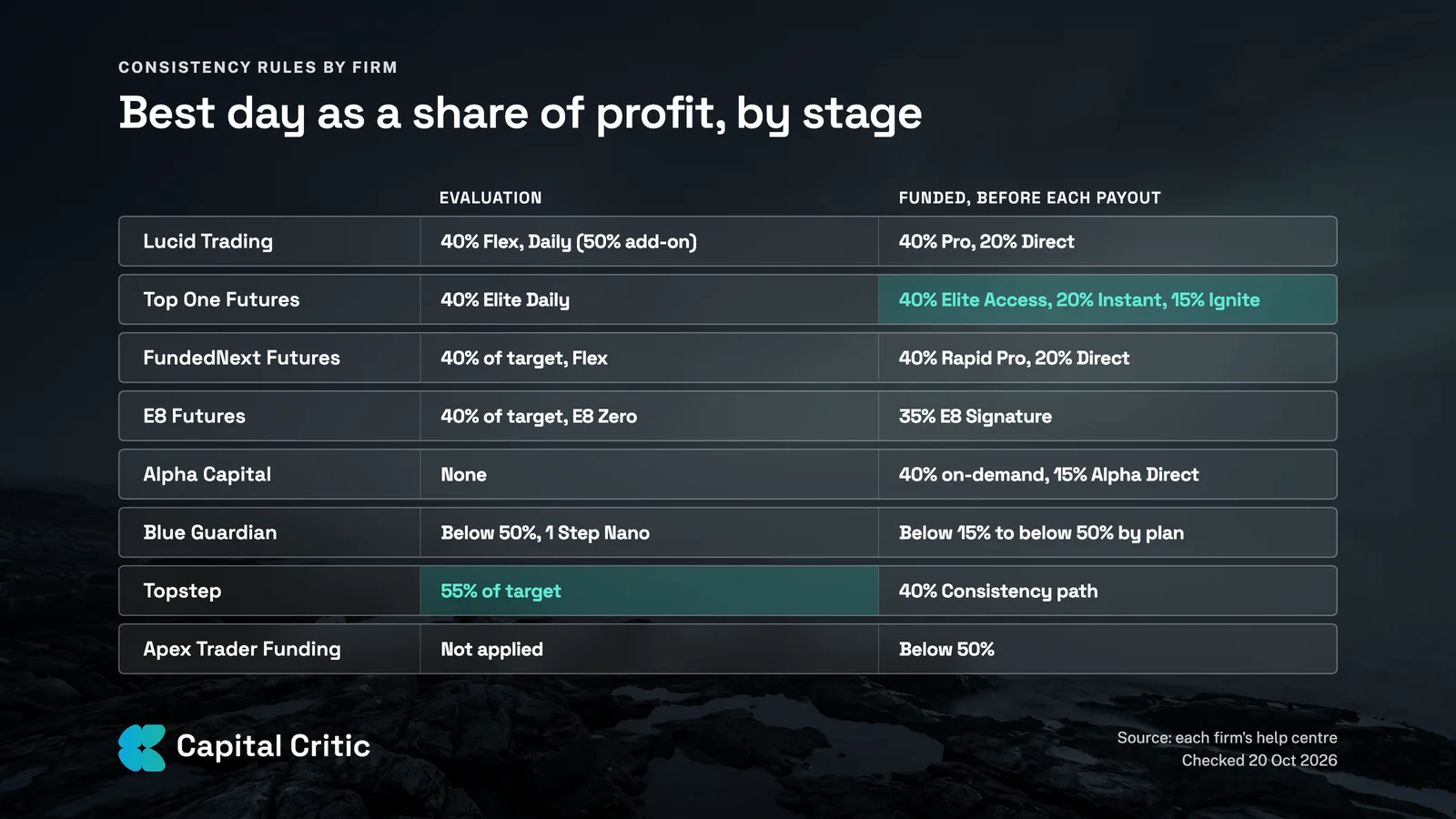
Source: each firm's help centre, checked 20 October 2026.
Where the rule sits matters as much as its percentage. An evaluation rule costs you time once: you keep trading until the best day fits and then you're done with it. A funded rule applies to every payout, usually resets when you're paid, and can stretch each payout cycle.
- Evaluation rules tend to be looser (40% to 55% on our list) and drop away once you're funded at Lucid Trading's LucidFlex and LucidDaily, Top One Futures' Elite Daily, FundedNext Futures' Flex and E8 Futures' E8 Zero.
- Funded rules tend to be tighter (15% to 50%) and most reset after each payout. Alpha Capital notes that even a partial withdrawal resets the score.
- Perpetual rules keep the record. On FundedNext Futures Direct, your best day ever must stay at 20% or less of the current cycle's profit, so a big day raises the bar for every cycle after it.
- Optional rules exist too. Lucid Trading sells a 50% evaluation consistency add-on at checkout on LucidFlex and LucidDaily (40% is standard), Topstep lets you pick a Standard or Consistency payout path when you activate an Express Funded Account, and Alpha Capital's best-day rule applies to on-demand payouts, not to the bi-weekly option on Alpha Pro and Alpha Three.
| Firm | Plan | Evaluation | Funded (before each payout) |
|---|---|---|---|
| Lucid Trading | LucidFlex, LucidDaily | 40% of evaluation profit (50% as a paid add-on) | None |
| Lucid Trading | LucidPro | None | 40%, resets after each payout (35% on accounts bought or reset before 28 Nov 2025) |
| Lucid Trading | LucidDirect | No evaluation | 20%, resets after each payout |
| Top One Futures | Elite Daily | 40% | None |
| Top One Futures | Elite Access | None | 40% of payout-cycle profit |
| Top One Futures | Instant Sim Funded, Ignite Instant Funding | No evaluation | 20% (Instant), 15% (Ignite) |
| FundedNext Futures | Flex | 40% of the profit target | None |
| FundedNext Futures | Rapid Pro, Rapid Daily | None | 40% (Rapid Pro), none (Rapid Daily) |
| FundedNext Futures | Direct | No evaluation | 20%, measured on your best day ever |
| E8 Futures | E8 Zero Starter, E8 Zero Max | 40% of the profit target | None |
| E8 Futures | E8 Signature | None | 35% |
| Alpha Capital | Alpha Pro, Swing, One, Three | None | 40% on on-demand payouts |
| Alpha Capital | Alpha Direct | No evaluation | 15%, after a 3% profit buffer |
| Blue Guardian | 1 Step and 2 Step Standard | None | None |
| Blue Guardian | Instant Standard, Instant Starter | No evaluation | Below 20% (15% on $300K and $400K), Instant Starter below 15% |
| Blue Guardian | 1 Step Nano, 2 Step Nano | Below 50% (1 Step Nano), none (2 Step Nano) | Below 50% |
| Topstep | Trading Combine, Express Funded Account | 55% of the profit target | 40% on the Consistency path, none on the Standard path |
| Apex Trader Funding | EOD Evaluation, Performance Account | Not applied | Below 50% |
Sources: each firm's help centre or rules page, checked 20 October 2026. Blue Guardian rows cover its forex accounts.
Consistency gates delay individual payouts, but firms that use them still process payouts in volume. In the last 30 days the tracked firms in this table showed $1,198,381 across 1,036 payouts at Top One Futures, $1,545,941 across 1,273 at Alpha Capital and $4,516,799 across 1,680 at Blue Guardian. The E8 Markets ($1,430,414, 553 payouts) and FundedNext ($13,971,727, 8,994 payouts) figures are company-wide, covering every market each firm runs, not just futures. These are a verified on-chain floor, not complete payout volume: payouts sent by bank wire or card leave no public trace. Lucid Trading, Topstep and Apex Trader Funding aren't on the tracker. Full figures are on our prop firm payouts pages.
Six of these firms are in our offer book. Code CRITIC gets you the best available offer at Lucid Trading, Top One Futures, FundedNext Futures, E8 Futures, Alpha Capital and Blue Guardian; it doesn't stack with other codes. If you're weighing a 55% evaluation against a 40% one, compare Lucid Trading vs Topstep or Top One Futures vs Topstep side by side.
How often do prop firms change their consistency rules?
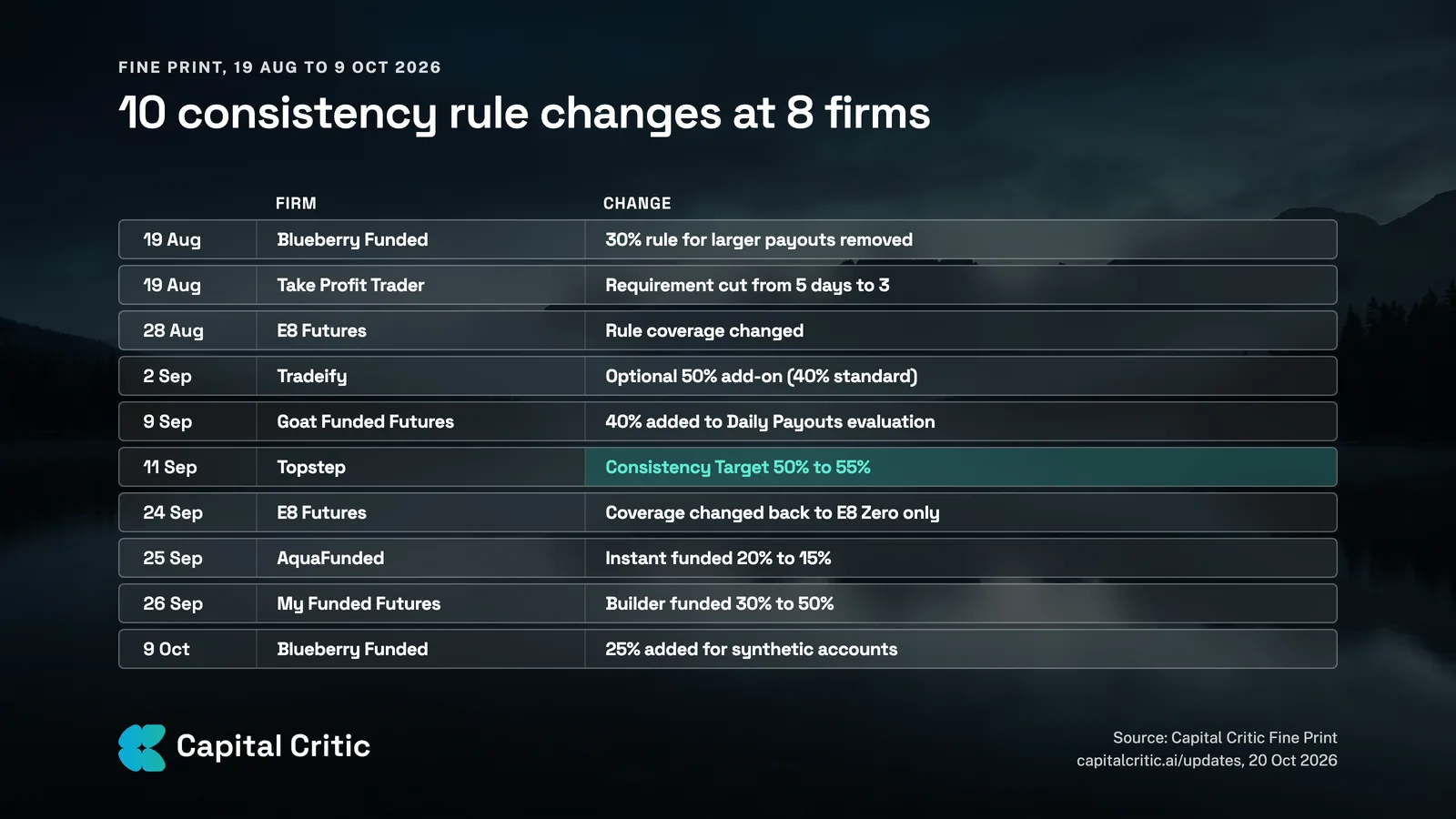
Source: Capital Critic Fine Print, capitalcritic.ai/updates, 20 October 2026.
Often enough that a rule you read last month may not be the one you buy. Fine Print, our tracker of firm rule pages, logged 10 consistency rule changes at 8 firms between 19 August and 9 October 2026, plus several wording clarifications. Every entry is public on the Fine Print updates page.
| Date (2026) | Firm | Change logged by Fine Print |
|---|---|---|
| 19 Aug | Blueberry Funded | A 30% best-day rule for larger payouts removed |
| 19 Aug | Take Profit Trader | Consistency requirement changed from 5 days to 3 days |
| 28 Aug | E8 Futures | Help-centre summary of which products carry a challenge-stage rule changed |
| 2 Sep | Tradeify | Optional 50% consistency add-on for the Select Evaluation (40% standard) |
| 9 Sep | Goat Funded Futures | 40% consistency added to the Daily Payouts evaluation, none once funded |
| 11 Sep | Topstep | Trading Combine Consistency Target moved from 50% to 55% of the profit target |
| 24 Sep | E8 Futures | Summary changed again: challenge-stage rule on E8 Zero only, none on E8 Pro or E8 Zero once funded |
| 25 Sep | AquaFunded | Instant funded consistency tightened from 20% to 15% |
| 26 Sep | My Funded Futures | Builder plans' funded consistency loosened from 30% to 50% |
| 9 Oct | Blueberry Funded | Rule extended to synthetic accounts at 25% once funded (Instant Lite stays at 15%) |
The changes run in both directions. Topstep, My Funded Futures, Take Profit Trader and Blueberry Funded's August removal made rules easier to meet; Goat Funded Futures, AquaFunded and Blueberry Funded's October extension made them stricter. Topstep's new wording also dropped a hidden cushion: its help centre now says "the old buffer was quiet padding on top of a 50% target" and that 55% is the number that counts. Lucid Trading made its own change in October, moving LucidFlex and LucidDaily evaluations to 40% as standard with 50% as a paid add-on, which we covered in our Lucid Trading on-demand payouts post.
Changes usually apply to new purchases, so two traders at the same firm can be on different numbers. LucidPro funded accounts bought or reset before 28 November 2025 stay at 35%, and Top One Futures says Ignite accounts on its older rule "remain unchanged." For the bigger picture of how firms rewrite their terms, see prop firm rule changes in 2026.
How do you trade with a consistency rule without overtrading?
Know your daily ceiling before the session, and treat a big day as a reason to trade smaller afterward, not larger. Most problems with consistency rules come from chasing the required total after one outsized win.
- Work out your ceiling. On a target-based rule it is the limit times the target: $1,200 on a $3,000 target at 40%, or the "less than $1,650" Topstep recommends on its $50K Trading Combine. On a total-profit rule, check the dashboard's live percentage before adding size.
- Use the platform's tools. Topstep points traders to a Personal Daily Profit Target on TopstepX that can liquidate or block trading once you reach a set gain.
- Don't split one trade across days to hide it. E8 says partial closes or hedges used to bypass its Best Day Rule may be consolidated into a single day, and Tradeify FX says partial closes may not be used to satisfy consistency requirements.
- Resolve a breach on a new day. Topstep notes that extra profit earned in the same session adds to the best day and raises the target further.
- Check what resets and when. Topstep's new payout window starts on the trading day after your request; FundedNext Futures Direct never forgets your record day.
Firm-specific walk-throughs: our E8 One rules guide covers a funded 40% best-day rule in detail, and our earlier piece on My Funded Futures' move to a consistency rule shows how a firm can trade drawdown rules for one. Before buying, read the rule on the firm's own help centre for the exact plan and purchase date; for one firm's full rule set, see our Lucid Trading review or Topstep review. Evaluation fees are money you can lose, and adding size to "catch up" a consistency total adds drawdown risk at the same time.
Frequently Asked Questions
What is a 40% consistency rule?
It means no single trading day can account for more than 40% of your total profit (or of the profit target, at firms that measure it that way). A $1,200 best day needs at least $3,000 in total profit to qualify.
Does breaking a consistency rule fail the account?
Not at the eight firms we checked. In an evaluation the effective profit target rises; on a funded account the payout request waits until your best day is back within the limit.
Do losing days count toward the consistency rule?
Yes, at firms that use net profit. A loss lowers your total and raises the percentage, and Topstep says a losing day never resets your best day.
Does the consistency rule reset after a payout?
Usually. Lucid Trading, Top One Futures, Topstep, Apex Trader Funding and Alpha Capital reset the calculation to the new payout window. FundedNext Futures Direct keeps your best day ever as the benchmark.
Which prop firms have no consistency rule?
Several plans have none at a given stage: LucidFlex and LucidDaily once funded, FundedNext Futures Rapid Daily at every stage, E8 Zero once funded, Blue Guardian's Standard challenges, Apex's evaluations and Topstep's Standard payout path. Check the specific plan, because the same firm can mix rules.
Is a higher consistency percentage better for traders?
A higher limit is looser: 50% lets one day supply half your profit, while 20% needs at least five days' worth of similar gains. Compare it with where the rule applies and whether it resets.