
The Lucid Trading consistency rule caps your largest single-day profit at a share of your total profit: 40% on most evaluations and on LucidPro funded accounts, 20% on LucidDirect, and none once you are funded on LucidFlex or LucidDaily. On every public plan the max loss limit trails your balance, then locks at the starting balance plus $100.
Rules and prices checked on Lucid Trading's website, pricing cards and help center on November 8, 2026.
Key takeaways
- Consistency is measured as largest single-day profit divided by total profit. To find the total you need, divide your best day by the limit: a $1,200 best day needs $3,000 at 40%.
- LucidFlex and LucidDaily evaluations use 40% as standard, with 50% as a paid add-on. LucidFlex moved from 50% to 40% in October 2026.
- LucidPro has no evaluation consistency rule but applies 40% to every funded payout cycle. LucidDirect applies 20%. Both reset after each payout.
- The max loss limit is $1,000, $2,000, $3,000 or $4,500 by size (LucidDirect: $3,500 at 100K and $5,000 at 150K). It trails your closing balance, then locks at the starting balance plus $100.
- On LucidFlex, the first payout moves the max loss limit straight to that locked level, which can leave only a few hundred dollars of room.
- LucidDaily funded accounts use an intraday drawdown in Lucid's help center; the pricing cards now also sell an EOD funded option with a 30% or 40% evaluation consistency choice.
Lucid Trading consistency and drawdown at a glance
| Plan | Evaluation consistency | Funded consistency | Drawdown (evaluation / funded) | Daily loss limit |
|---|---|---|---|---|
| LucidPro | None (pass in one day) | 40% per payout cycle | EOD / EOD | Optional at checkout |
| LucidFlex | 40%, or 50% with the add-on | None | EOD / EOD | Optional at checkout |
| LucidDaily | 40%, or 50% with the add-on (30% or 40% with EOD funded drawdown) | None | EOD or intraday / intraday (EOD option on the cards) | Optional at checkout |
| LucidDirect | No evaluation | 20% per payout cycle | No evaluation / EOD | Set by size (none at 25K) |
| Live account | Not applicable | None | Not applicable / EOD, locks at $100 | None |
What is the Lucid Trading consistency rule on each plan?

Most Lucid plans judge your largest day against your total profit.
The Lucid Trading consistency rule limits how much of your profit can come from one day, and the limit depends on the plan and the stage: 40% or 50% in LucidFlex and LucidDaily evaluations, 40% in LucidPro funded accounts, 20% in LucidDirect, and nothing on live accounts.
| Plan | Evaluation | Funded (simulated) | Live |
|---|---|---|---|
| LucidPro | No consistency rule; can pass in one day | 40% of profit in each payout cycle (35% on accounts bought or reset before November 28, 2025) | None |
| LucidFlex | 40%, or 50% with the paid add-on | None | None |
| LucidDaily | 40%, or 50% with the paid add-on; 30% or 40% if you choose EOD funded drawdown | None | None |
| LucidDirect | No evaluation (straight to funded) | 20% of profit in each payout cycle | None |
| LucidMaxx (invitation only) | Step 1: 40%; Step 2 (Pre-Live): none | Not applicable | None |
Two stages work differently. In an evaluation, the rule is checked when you hit the profit target: if your best day is above the limit, you don't fail, you simply keep trading until the best day is back within it. In a LucidPro or LucidDirect funded account, the rule is one of the payout conditions and is measured on the profit made since your last payout, so it starts again from zero after every approved payout.
The October 2026 LucidFlex change
Lucid lowered the standard LucidFlex evaluation limit from 50% to 40% in October 2026, a change our Fine Print monitor logged on October 19. The 50% limit is still available as an add-on at checkout for a small fee. With 40% you can pass in as few as 3 days; with 50%, in as few as 2. The choice is fixed once you buy: Lucid says checkout settings can't be changed on an active account.
LucidDaily: 40%, 50% and the new 30% option
LucidDaily follows the same 40% standard with a 50% add-on, according to its customization article and the pricing cards. Lucid's older LucidDaily evaluation article still lists 50% for every size, so read the rule on your own dashboard. The cards now add one more combination: if you pick an EOD drawdown in the evaluation and EOD in funded, the consistency choice becomes 30% or 40%, and 50% is not offered with that setup.
How do you calculate the Lucid Trading consistency rule?
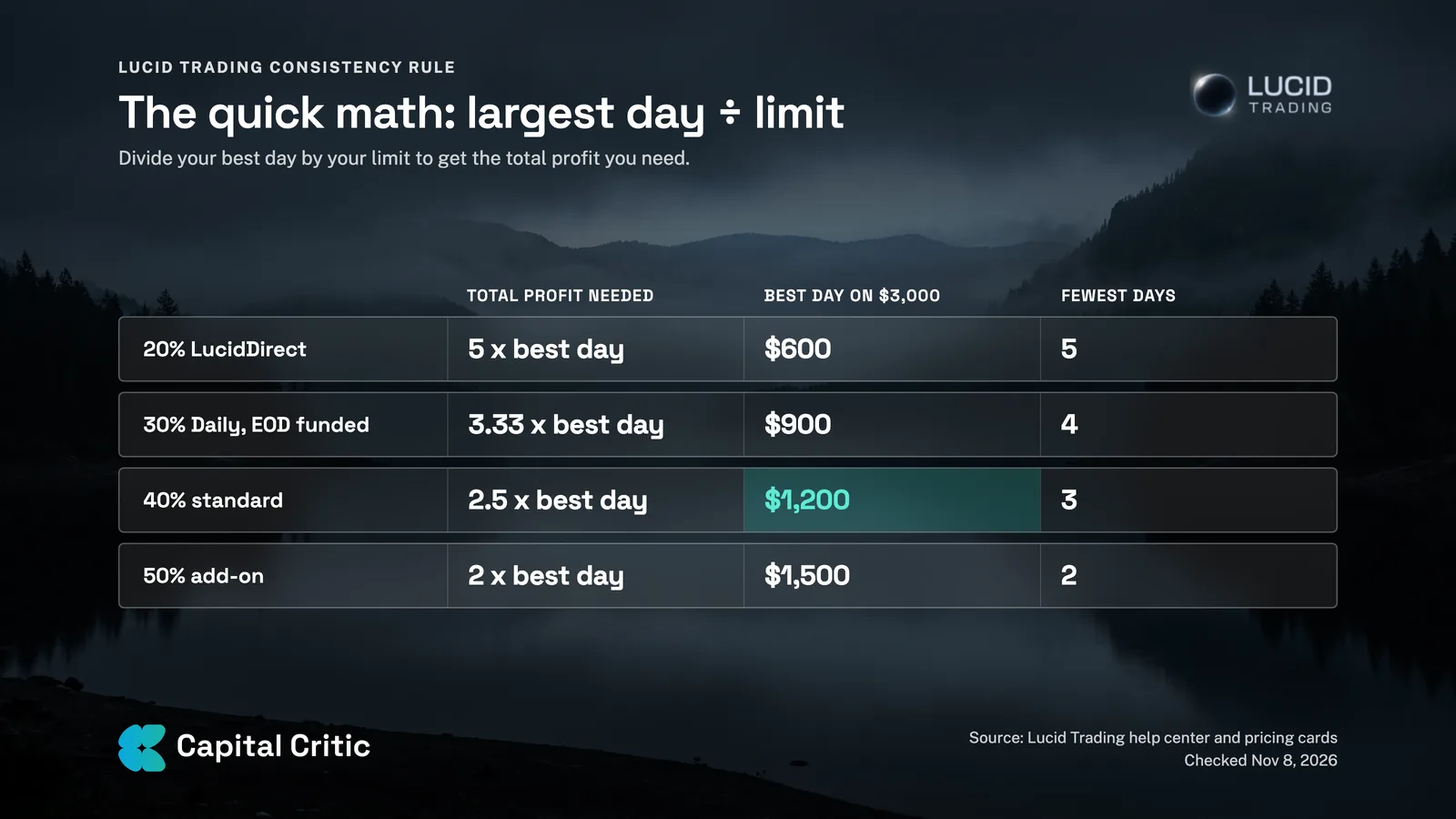
Lucid Trading consistency rule math. Source: Lucid Trading help center and pricing cards, checked Nov 8, 2026.
Divide your largest single-day profit by your total profit and compare the result with your plan's limit. Lucid's formula is "Largest Single Day Profit / Account Profit = Consistency Percentage", and a result at or below the limit passes.
The reusable version runs the other way: total profit you need = largest day ÷ limit. It tells you how far you still have to go after a big day.
| Limit | Where it applies | Total profit needed | Largest day allowed on $3,000 of profit | Fewest days to reach $3,000 |
|---|---|---|---|---|
| 20% | LucidDirect funded | 5 x your best day | $600 | 5 |
| 30% | LucidDaily evaluation with EOD funded drawdown | 3.33 x your best day | $900 | 4 |
| 40% | LucidFlex and LucidDaily evaluations, LucidPro funded, LucidMaxx Step 1 | 2.5 x your best day | $1,200 | 3 |
| 50% | LucidFlex and LucidDaily add-on | 2 x your best day | $1,500 | 2 |
Worked example: a 50K LucidFlex evaluation
Suppose you trade a $50K LucidFlex evaluation with the standard 40% limit and a $3,000 profit target. You make $1,400, $900 and $700 on three days and reach $3,000.
- Consistency: $1,400 ÷ $3,000 = 46.7%, above the 40% limit, so the account doesn't pass yet.
- Total needed: $1,400 ÷ 0.40 = $3,500, so you need another $500 of net profit without a new day above $1,400.
- With the 50% add-on, the same three days pass at 46.7%.
A larger day while you catch up raises the bar again, and the drawdown keeps applying the whole time. Lucid's own example on the LucidFlex consistency page uses a $750 best day on the same account: $750 ÷ $3,000 = 25%, a pass.
Worked example: a 50K LucidPro payout cycle
In a funded LucidPro account the 40% limit applies to the profit in the current payout cycle. Suppose a $50K account makes $1,400, $600, $500 and $300 in one cycle, $2,800 in total and a balance of $52,800.
- Consistency: $1,400 ÷ $2,800 = 50%, so no payout yet.
- Total needed: $1,400 ÷ 0.40 = $3,500 of cycle profit, a balance of $53,500.
- At $53,500, the other conditions are met: at least $500 of profit in the cycle and a balance above the $52,100 buffer. The most you can take is $1,400, the profit above the buffer, within the $2,000 cap on a first payout.
After the payout, the 40% check starts again on the next cycle's profit. LucidDirect works the same way at 20%: Lucid's example is a $500 best day on $3,000 of profit, 16.7%.
The cushion on the 50% option
Lucid builds a small cushion into the 50% option so a trader can pass in two days. Its example table shows a largest day of $650 on the $25K account ($1,250 target), $1,560 on 50K, $3,120 on 100K and $4,680 on 150K. Lucid adds that the cushion is a percentage of your actual day and "NOT a fixed dollar amount", so treat 50% as the line you plan around. For a deeper look at why firms use these rules, see our prop firm consistency rule explainer.
How does the Lucid Trading drawdown work?
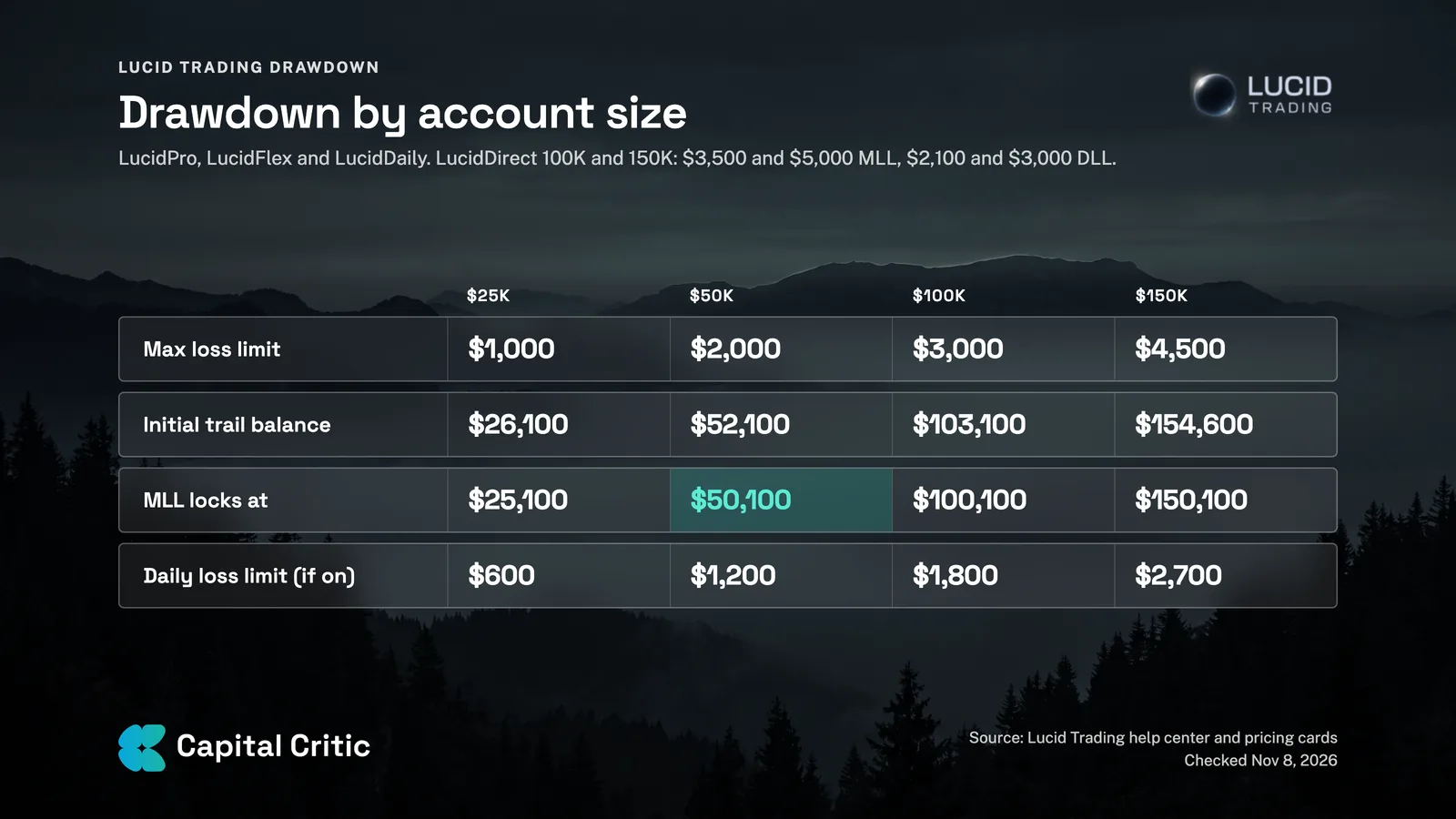
Lucid Trading drawdown by account size. Source: Lucid Trading help center and pricing cards, checked Nov 8, 2026.
Lucid Trading uses a trailing max loss limit (MLL) that follows your highest closing balance and stops moving once the account closes above the initial trail balance, at which point it locks at the starting balance plus $100. LucidPro, LucidFlex and LucidDirect use end-of-day (EOD) calculation throughout; LucidDaily lets you pick EOD or intraday for the evaluation.
| Size | Max loss limit | Initial trail balance | MLL locks at | Daily loss limit (if on) |
|---|---|---|---|---|
| $25K | $1,000 | $26,100 | $25,100 | $600 |
| $50K | $2,000 | $52,100 | $50,100 | $1,200 |
| $100K | $3,000 (LucidDirect $3,500) | $103,100 (LucidDirect $103,600) | $100,100 | $1,800 (LucidDirect $2,100) |
| $150K | $4,500 (LucidDirect $5,000) | $154,600 (LucidDirect $155,100) | $150,100 | $2,700 (LucidDirect $3,000) |
On a $50K EOD account the MLL starts at $48,000. Close the first day at $51,000 and it moves to $49,000. Close a later day at $52,300, above the $52,100 trail balance, and it locks at $50,100 and stays there. The level is set from closing balances, but if your balance reaches it, Lucid breaches the account. LucidDirect has no daily loss limit at 25K, and the 25K LucidPro card lists a $600 limit where the help center's older table shows none; the cards are what you buy.
EOD or intraday on LucidDaily
LucidDaily is the plan where the drawdown type is a real choice. An EOD evaluation moves the MLL only with your end-of-session balance and costs more; an intraday evaluation moves it with real-time profit and loss, open trades included, and costs less. Lucid's LucidDaily customization article says every LucidDaily funded account uses an intraday drawdown, whatever you choose for the evaluation. With intraday, an open trade that reaches $1,000 of unrealized profit on a $50K account lifts the MLL from $48,000 to $49,000 straight away, even if the trade then closes flat.
On Lucid Trading's pricing cards, an EOD LucidDaily evaluation now also offers "Drawdown In Funded: EOD" at a higher price, which keeps the end-of-day calculation after you pass. The help center hadn't described that option yet when we checked, so confirm which rule your account carries before you trade it. If the distinction is new to you, our guide to EOD vs trailing drawdown walks through both.
Daily loss limit: a soft breach
Every Lucid daily loss limit is a soft breach: hitting it locks you out until the next session, and the account survives as long as the MLL isn't reached. On LucidPro and LucidDirect funded accounts, the fixed limit is replaced by the LucidScale limit once the account closes above the initial trail balance: 60% of your highest end-of-day profit, which only goes up. Lucid's example is $4,000 × 60% = $2,400. On LucidDaily the limit stays fixed in both stages and doesn't trail, so if the MLL trails above it during a session, the MLL becomes the tighter level. Keeping the limit on is also what gives Flex, Pro and Daily accounts on-demand payouts.
What happens to the Lucid drawdown after a payout?

On LucidFlex, the first payout locks the max loss limit at the starting balance plus $100.
On LucidFlex, the first payout moves the max loss limit straight to the locked level, the starting balance plus $100, whatever your balance is. On LucidPro, LucidDaily and LucidDirect, payouts only come from profit above a set level, so the remaining room is larger.
LucidFlex: the MLL jumps to the lock
LucidFlex has no buffer. You qualify after 5 days with at least the minimum daily profit ($100, $150, $200 or $250 by size) and positive net profit in the cycle, and you can request 50% of your profit up to $1,000, $2,000, $2,500 or $3,000. Lucid's LucidFlex drawdown page says that once you request a payout, the MLL "automatically adjusts to the Locked MLL Balance".
Suppose a $50K LucidFlex funded account is at $51,200 after five qualifying days, with the MLL trailing at $49,200. You request 50% of the $1,200 profit, $600. The balance drops to $50,600 and the MLL moves to $50,100, so your room shrinks from $2,000 to $500. The smallest possible request, $500, needs $1,000 of profit and leaves you $400 above the MLL. Up to 5 payouts are allowed per LucidFlex account, after which Lucid moves you to live.
LucidPro and LucidDaily: the buffer protects the room
LucidPro and LucidDaily only pay out profit above a buffer equal to the initial MLL plus $100: $26,100, $52,100, $103,100 or $154,600. Since the MLL can't rise above the starting balance plus $100, a payout always leaves at least the full drawdown amount between your balance and the MLL. LucidDaily has no per-request cap: you can take everything above the buffer, and making the maximum daily profit ($6,000, $8,000, $10,000 or $12,000 by size) moves the account to live.
LucidDirect: profit goals instead of a buffer
LucidDirect requires a profit goal in each cycle ($3,000 for the first payout on a $50K account, $2,500 after that) and the 20% consistency rule. With a $2,000 maximum first payout, a $50K account at $53,000 would sit at $51,000 afterwards, $900 above an MLL locked at $50,100.
Live accounts
Accounts moved to live start with a $0 balance, no daily loss limit, no consistency rule and an EOD drawdown equal to the funded MLL for that size. Per Lucid's live structure page, that drawdown locks at $100 once live profit equals the starting drawdown, or straight away if you request a live payout before that. Lucid isn't on our on-chain payout tracker, so we have no payout figure of our own for it.
What do Lucid's consistency and drawdown options cost?
Each option changes the evaluation price: the 50% consistency add-on, the DLL off setting and the EOD drawdown choices cost more, while the 30% LucidDaily option costs less than 40% with the same EOD funded setup. Code CRITIC gets you the best available offer at Lucid Trading; the prices below are list first, then the price with CRITIC as Lucid's cards showed it on November 8, up to 30% off list. DLL off, the 50% add-on and EOD funded drawdown are priced on top of the list price, so some totals sit above it. All Lucid evaluations are one-time fees with no activation fee.
LucidFlex
| LucidFlex option | $25K | $50K | $100K | $150K |
|---|---|---|---|---|
| List price | $65 | $115 | $215 | $323 |
| With CRITIC: DLL on, 40% | $45.50 | $80.50 | $150.50 | $226.10 |
| With CRITIC: DLL on, 50% | $50.40 | $90.30 | $170.10 | $250.60 |
| With CRITIC: DLL off, 40% | $60.20 | $115.50 | $195.30 | $265.30 |
| With CRITIC: DLL off, 50% | $70 | $130.20 | $215.60 | $295.40 |
LucidDaily with an intraday evaluation
| LucidDaily option (intraday evaluation, intraday funded) | $25K | $50K | $100K | $150K |
|---|---|---|---|---|
| List price | $72 | $94 | $158 | $229 |
| With CRITIC: DLL on, 40% | $50.40 | $65.80 | $110.60 | $160.30 |
| With CRITIC: DLL on, 50% | $55.30 | $75.60 | $125.30 | $180.60 |
| With CRITIC: DLL off, 40% | $65.10 | $90.30 | $150.50 | $210 |
| With CRITIC: DLL off, 50% | $75.60 | $100.10 | $170.10 | $235.20 |
LucidDaily with an EOD evaluation
| LucidDaily option (EOD evaluation) | $25K | $50K | $100K | $150K |
|---|---|---|---|---|
| List price | $86 | $122 | $200 | $286 |
| With CRITIC: intraday funded, DLL on, 40% | $60.20 | $85.40 | $140 | $200.20 |
| With CRITIC: intraday funded, DLL on, 50% | $65.10 | $95.20 | $155.40 | $220.50 |
| With CRITIC: intraday funded, DLL off, 40% | $80.50 | $115.50 | $180.60 | $250.60 |
| With CRITIC: intraday funded, DLL off, 50% | $90.30 | $130.20 | $200.20 | $280 |
| With CRITIC: EOD funded, DLL on, 30% | $90.30 | $130.20 | $215.60 | $305.20 |
| With CRITIC: EOD funded, DLL on, 40% | $115.50 | $165.20 | $270.20 | $385 |
| With CRITIC: EOD funded, DLL off, 30% | $125.30 | $185.50 | $280 | $390.60 |
| With CRITIC: EOD funded, DLL off, 40% | $160.30 | $235.20 | $350 | $490 |
LucidPro and LucidDirect
| Option | $25K | $50K | $100K | $150K |
|---|---|---|---|---|
| LucidPro list price | $108 | $172 | $272 | $365 |
| LucidPro with CRITIC: DLL on | $75.60 | $120.40 | $190.40 | $255.50 |
| LucidPro with CRITIC: DLL off | $90.30 | $150.50 | $225.40 | $300.30 |
| LucidDirect list price | $329 | $515 | $700 | $836 |
| LucidDirect with CRITIC | $230.30 | $360.50 | $490 | $585.20 |
Put side by side, the consistency choice is cheap and the drawdown choice is not. On a $50K LucidFlex with the DLL on, the 50% add-on costs $9.80 more with CRITIC ($90.30 against $80.50). On a $50K LucidDaily with an EOD evaluation and the DLL on, EOD funded drawdown takes the price from $85.40 to $130.20 at 30% or $165.20 at 40%. CRITIC matches the best offer Lucid runs and doesn't stack with other codes; our Lucid Trading offers page shows the current terms. Futures trading carries real risk, and most traders should treat an evaluation fee as money they may not get back. For how the plans compare beyond these two rules, see our Lucid Trading account types guide and our Lucid Trading review.
Frequently Asked Questions
Does Lucid Trading have a consistency rule on funded accounts?
On two plans. LucidPro funded accounts need a 40% consistency percentage in each payout cycle (35% on accounts bought or reset before November 28, 2025), and LucidDirect needs 20%. LucidFlex and LucidDaily funded accounts have no consistency rule, and live accounts have none on any plan.
Does the Lucid consistency rule reset after a payout?
Yes. On LucidPro and LucidDirect the consistency percentage is measured on the profit since your last payout and resets after each approved payout. LucidFlex's 5 days of minimum profit also reset after every payout.
Is the Lucid Trading drawdown trailing or static?
Trailing, until it locks. The max loss limit follows your highest closing balance (or real-time balance on intraday LucidDaily accounts) until the account passes the initial trail balance, then locks at the starting balance plus $100. Live accounts get a new EOD drawdown that locks at $100; only LucidMaxx live accounts use a static drawdown.
What happens to the LucidFlex drawdown after a payout?
It moves to the locked level, the starting balance plus $100 ($50,100 on a $50K account), as soon as you request the payout. Because LucidFlex has no buffer, an early payout can leave only a few hundred dollars between your balance and the max loss limit.
Can I change the consistency or drawdown option after buying?
No. Lucid says the settings chosen at checkout, including the daily loss limit, the consistency percentage and the LucidDaily drawdown type, can't be changed on an active account. You would need to buy a new account with the options you want.
Is news trading allowed with Lucid Trading?
Yes on LucidFlex, LucidPro and LucidDirect. LucidDaily funded accounts must be flat from 1 minute before to 1 minute after high-impact USD news, and trading through that window is a hard breach.